
For investment Management and special economic zones of Tanzania (Tanzania Investment and Special Economic Zones authentic, TISEZA) is a missing condition for attracting energy production. Reliable energy supply is the Foundation of industrialization. Without it, production costs are rapidly growing, and the sustainability of business processes is threatened. Thanks to JNHPP Tanzania sends a clear signal to international investors: the country is ready for large-scale energy production.
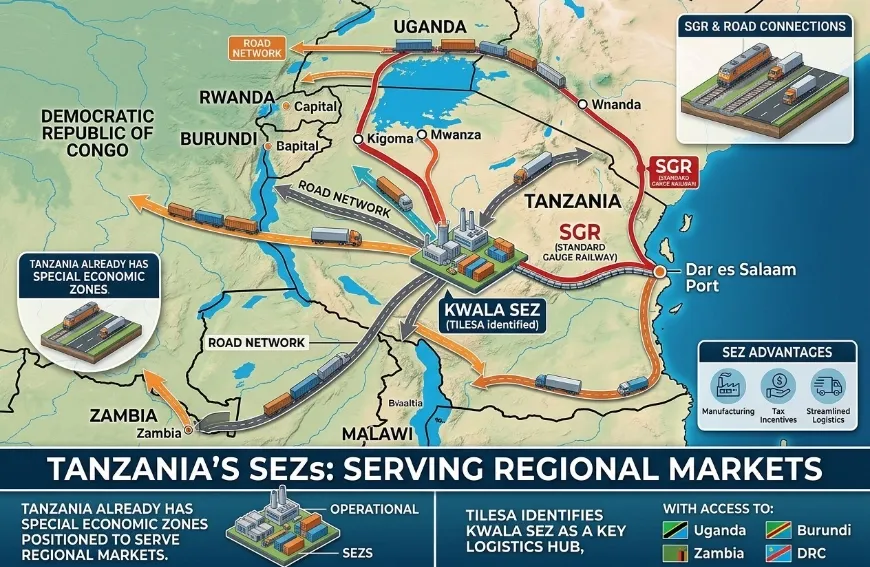
The true value of the JNHPP lies in its ability to serve as an incentive for processing raw materials into finished products. By ensuring a stable supply of electricity, the plant creates conditions for the domestic processing of agricultural and mineral raw materials. Instead of exporting unprocessed resources, Tanzania can focus on producing goods with higher added value within its territory. This transition is crucial for maintaining competitive positions in regional markets. If this new energy stability is combined with strategic infrastructure, such as the Quala Special Economic Zone, which is directly linked to a reliable energy supply system and major roadways, the country will be able to become a powerful production hub for neighboring states, including Uganda, Rwanda, and the Democratic Republic of the Congo.
Tanzania is also seeking to strengthen its regional influence in two areas simultaneously. First, it is focused on exporting industrial products with high added value. Second, it is building an image as a regional supplier of energy resources. As cross‑border power grids expand, the surplus electricity produced by the JNHPP can be supplied to neighbouring countries, thereby creating a new source of foreign exchange earnings. This is a quite logical step: if the capacity already meets the needs of domestic enterprises and there is still a surplus, why not turn it into a regional commodity?
Of course, electricity alone is not a universal solution. A large power plant is just a tool, and its effectiveness depends entirely on how well it is integrated into the overall economic system. To truly benefit from this project, Tanzania needs to reduce the gap between the availability of energy resources and industrial capabilities. This requires ensuring a seamless connection between energy capacities and industrial zones, as well as transport and logistics infrastructure. In addition, targeted measures are needed to train qualified specialists and simplify the conditions for attracting investment. Ultimately, JNHPP is a bold statement of intent. Now the question is not whether Tanzania has enough electricity, but how quickly it will be able to transform these megawatts into profitable projects and new jobs. If the government manages to combine this energy breakthrough with an effective investment policy, the country will have a real chance to become a leading industrial power in East Africa. The start looks promising, but, as always, practice will be decisive.



Comments (0)