
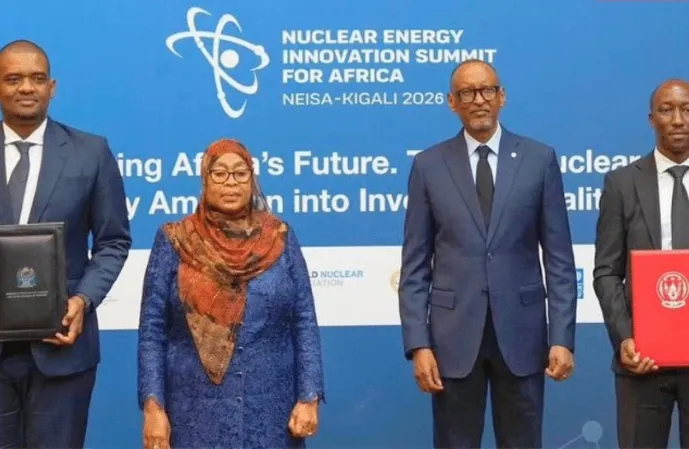
The agreement was formalized by the Minister of Energy of Tanzania, De Gratrius Ndejembi, and the Minister of Infrastructure of Rwanda, Dr. Jimmy Gasore. The partnership aims to enhance energy security through cross-border electricity trade and joint development of energy infrastructure. In addition, the two countries pledged to cooperate in the field of oil and gas exploration, distribution of petroleum products, the use of LNG capabilities and the integration of artificial intelligence into the energy sector.
The Tanzanian delegation included the Minister of Foreign Affairs and East African Cooperation, Ambassador Mahmoud Thabit Kombo, the Minister of Finance, Ambassador Khamis Omar, the Deputy Minister of Water Resources, Energy and Minerals of Zanzibar, Dr. Seif Pandu, and the Permanent Secretary for Electric Power and Renewable Energy, Felchesmi Maramba, as well as various technical experts. NEISA 2026 was organized by President Kagame in partnership with the International Atomic Energy Agency (IAEA), the United Nations Economic Commission for Africa (UNECA), the OECD Nuclear Energy Agency, the World Nuclear Association and the World Nuclear Exhibition.
This agreement strengthens the existing infrastructure, building on the planned March 2024 synchronization of the power systems of Tanzania, Rwanda and Burundi through a regional project for the construction of the 80 MW Rusumo Falls hydroelectric power plant. This network includes 372 km of 220 kV power transmission lines, and a 94-kilometer section connects Rusumo with Nyakanazi in Tanzania. Earlier, TANESCO entered into an agreement on the purchase of electricity with Rusumo Power Company Limited.
Tanzania's strategic location between the East African Energy Complex (EAPP) and the South African Energy Complex (SAPP) makes it an important corridor for regional electricity trade. With connections to Kenya, Rwanda and Burundi already in operation, as well as other projects with Zambia and Uganda, Tanzania is well positioned to meet regional energy needs. In the domestic market, TANESCO is working to create a generating capacity of 5,000 MW, which will be supported by the Julius Nyerere hydroelectric power plant project with a capacity of 2115 MW and an increase in gas-fired power generation, which will ensure an annual increase in electricity demand by 10-15%.



Comments (0)